PLACE RECORD — TATE & NELSON, GEORGIA
The Tate Georgia Marble Quarry
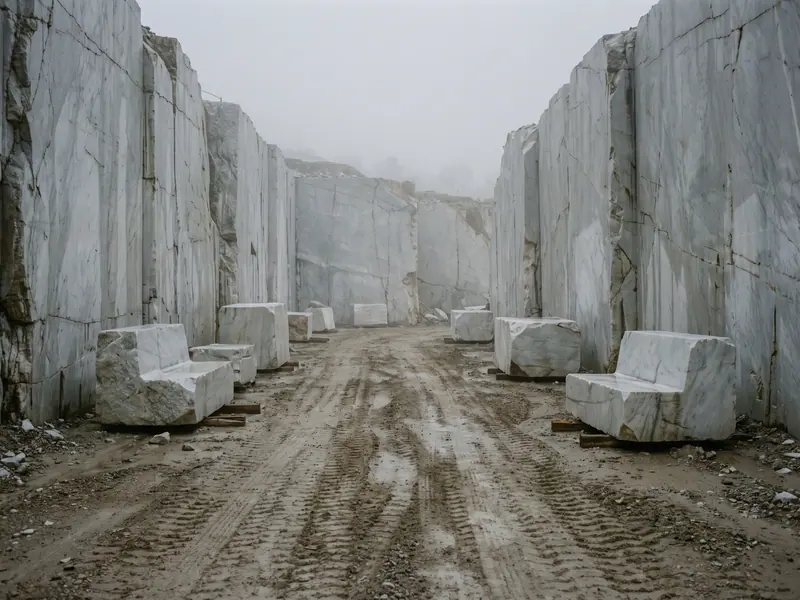
The marble deposit at Tate, Georgia was found in 1835 by Henry T. Fitzsimmons, an itinerant Irish stone cutter, on Samuel Tate's north Georgia property near what became Marble Hill, GA. The Georgia Marble Company was founded on Samuel Tate's land in 1884, and commercial quarrying has continued from that date. Today, Polycor Inc. operates an active Georgia Marble Quarry and Georgia Marble Plant at Tate, GA, along with a Marble Hill Quarry, GA, quarrying and marketing Georgia Marble varieties.
The north Georgia marble belt
Tate sits within the north Georgia marble belt, the geological formation that carries the deposit found in 1835 through this part of the state. The quarry stone is close to pure white crystalline calcium carbonate — the purity that also made a separate industrial, ground-calcium-carbonate business possible from the same deposit. The company has long described the stone's unusually large interlocked crystals as resisting penetration by moisture and water-borne dirt, and its purity as helping it wear evenly; this is a long-standing company description rather than an independently lab-verified performance claim.
The deposit is worked as an open quarry pit at Tate, cut down in stepped benches to follow the marble body.
Nelson, Georgia: the Structural Products Plant
Historically, the company operated two dimension-stone plants: the Memorial Products Plant at Tate, GA, and the Structural Products Plant at Nelson, GA. The Nelson plant fabricated panels, columns, floor tile, thresholds, sills, benches, signage, and custom architectural work, and also imported marble and granite from international sources. Products historically produced there included Marblstal, a permanent marble partition system for restrooms, washrooms, shower and dressing rooms, prefabricated in standard packages or custom fabricated, and American Classics Marble Tile, cut in nine varieties to 12" x 12" x 3/8", polished on one face with beveled top edges. The plant also supported Pathways, a fundraising programme using sandblasted personalization of marble and clay pavers, benches, and signage.
The Nelson plant's current operating status under Polycor is not confirmed, and this page describes it as a historical structure rather than a present-day operation.
Craft passed down
The people who have quarried and cut this stone are part of its record as much as the marble itself. At Tate and Nelson, work on the deposit has been carried on by fabricators whose fathers and grandfathers quarried and cut the same stone before them — a continuity of craft running alongside the continuity of the quarry itself, from the 1884 founding to the present.
Tracing a stone to this quarry
If you are trying to trace a stone, monument, or building element back to Tate or Nelson, or need help confirming a match against a named Georgia Marble variety, you can send what you know through our contact page.